
I in ICT
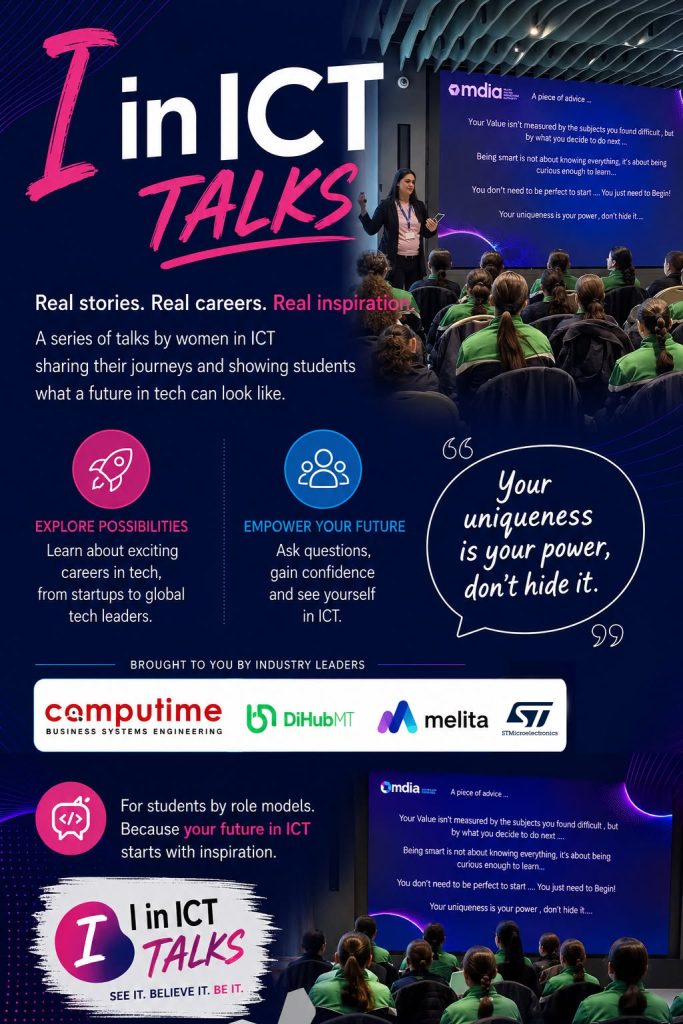
Theme: Promoting digital careers
Phase and Stage: STEM- Secondary education
Action: Introducing role models
Beneficiaries: Children; Private companies
Users: Education providers; Private companies
“I in ICT” is an awareness-raising and outreach initiative developed to encourage young people, particularly girls, to consider future studies and careers in Information and Communication Technology (ICT). It targets students in lower-secondary education, approximately 11–14 years old, reaching them before important educational and subject choices are made.
The initiative evolved from an earlier “Girls in ICT” approach and was subsequently broadened to include both girls and boys, while retaining a strong focus on female participation in technology. Its objective is to increase awareness of the diversity of ICT careers, make these pathways more relatable and accessible, and challenge perceptions about who can pursue and succeed in technology-related professions.
THE CHALLENGE
The key challenge is the comparatively low participation of women in ICT and the persistence of perceptions and stereotypes which may discourage girls from considering technology-related pathways.
For school-aged girls, technology careers can appear distant or abstract. Often ICT can be perceived too narrowly as “programming” rather than as a diverse field encompassing numerous technical and tech-related roles. This creates a need to intervene early to help students form accurate perceptions of the field before they are called on to make educational choices which later influence their career options.
OUR SOLUTION
The initiative brings students into direct contact with ICT professionals through school visits, career-awareness talks and industry engagement activities. Particular emphasis is placed on featuring women working in ICT and digital innovation, providing girls with visible and relatable role models and first-hand accounts of careers in the sector.
Importantly, the programme engages both girls and boys. This approach avoids treating inclusion as an issue to be addressed solely with girls. Hearing from female ICT professionals helps boys to recognise at a young age that women play important roles in technical fields.
Schools, employers, ICT professionals and public-sector stakeholders are brought together to expose students to different career possibilities and enable them to ask questions directly of people working in the sector.
OUTCOMES
The initiative has reached a substantial number of students through several different formats.
For example, past activities include:
• One session bringing together 25 female students with female professionals at Malta Digital Innovation Authority
• Two talks at Maria Regina College Naxxar Middle School, delivered with STMicroelectronics, reaching mixed cohorts totalling approximately 50 students
• Three sessions at St Joseph School, Blata l-Bajda, reaching 48 female students, with contributions from Melita plc professionals
• A session at St Joseph School, Paola, reaching approximately 24 female students, in collaboration with Computime professionals
Qualitatively, the programme has created opportunities for students to interact directly with ICT professionals, hear their first-hand career experiences, ask questions and encounter a broader range of ICT roles. Supporting resources have also been developed to support students’ continued explorations of ICT careers beyond the talks.
KEY TAKEAWAYS
• Intervene early: career awareness should begin before students make important educational and subject choices.
• Make role models visible and relatable: direct contact with women already working in ICT can make a technology career less abstract and provide girls with tangible examples of possible pathways.
• Engage girls and boys together: rather than presenting ICT inclusion solely as a women’s issue, let the whole cohort of girls and boys hear about IT roles directly from women in tech. This helps boys develop a positive view of female participation in IT, while providing relevant career guidance to all regarding ICT careers.
• Bring industry into the conversation: collaboration with employers gives students access to first-hand experiences and demonstrates the breadth of real-world ICT careers.
• Allow interaction rather than relying only on presentations: opportunities to ask questions and speak directly with professionals help students connect career pathways with real people and experiences.


