
On 25 February 2026, we hosted the second webinar within our #WIDForum series, bringing together researchers and practitioners to explore a key question: how can early education help close the gender gap in STEAM fields?
Two speakers presented complementary perspectives: Paula Walsh lecturer in Early Childhood Education at South East Technological University in Ireland, and Anastasia Liopetriti, co-founder of the Girls in STEAM Academy in Cyprus.
Starting STEAM earlier
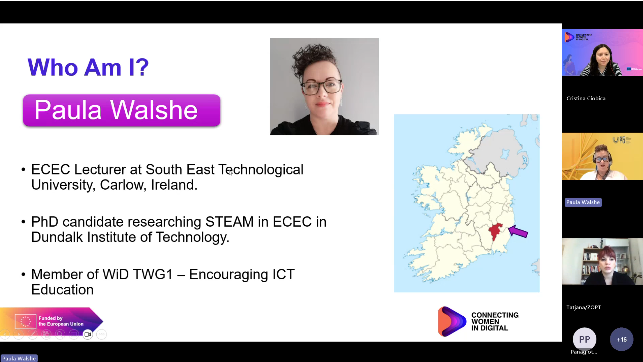
Paula Walshe opened the session by presenting insights from her doctoral research on STEAM in early childhood education.
Her work focuses on children before they enter formal primary school, a stage often overlooked in discussions of STEM pathways. Yet this phase is crucial in shaping curiosity, creativity, and early attitudes toward science and technology.
As Walshe explained, early intervention is key to addressing the gender gap later in life:
“We need to start earlier, in pre-primary education, to support early and sustained engagement with STEAM.”
Her research investigated the barriers that prevent educators from integrating STEAM into their practice. Through surveys and focus groups with early childhood educators, she identified several key challenges, including uncertainty about how to define STEAM, misconceptions about technology, and limited training opportunities.
A major insight from the study was that training alone is not enough.
“There’s no point in increasing educators’ ability if they’re not willing to bring it into their practice when they return to the classroom.”
To address this, Walshe developed the “STEAM from the Start” conceptual framework, which supports educators in both understanding the value of STEAM and learning how to integrate it into everyday learning activities.
Rethinking technology in early learning
One of the most interesting discussions during the webinar focused on how technology is often misunderstood in early education.
Many educators associate technology primarily with screens or digital devices, which can lead to resistance when introducing STEAM activities with young children.
Walshe highlighted the importance of broadening this definition:
“Technology wasn’t invented when the internet was invented. Technology is simply an innovation that humans created to make something easier to do.”
This perspective opens the door to many accessible and screen-free learning activities. Everyday objects, such as magnifying glasses, scales, microscopes, or simple construction materials, can all become tools for exploring scientific and technological concepts.
For example, children might build a robot from recycled materials or explore coding concepts through a visual recipe used to make playdough.
According to Walshe, these playful activities support the development of critical thinking, problem-solving, and analytical skills, which are essential for digital competence later in life.
From research to real-world action
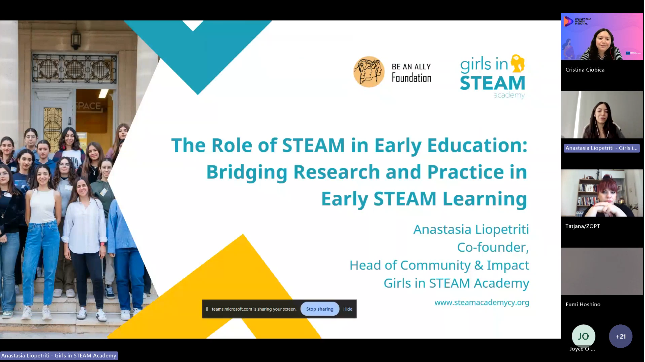
While Walshe focused on early education systems, Anastasia Liopetriti presented a complementary perspective from outside the classroom.
As co-founder of the Girls in STEAM Academy, she shared how the organisation works to empower girls through practical STEAM learning experiences and community initiatives.
Founded in Cyprus in 2021, the nonprofit initiative aims to tackle the under-representation of women and girls in STEAM fields.
“Our goal is to close the gap in the under-representation of women and girls in STEAM by translating policy priorities into practical learning experiences.”
The organisation places particular emphasis on accessibility and inclusion, working with girls from rural areas, public schools, and socio-economically disadvantaged backgrounds.
Through workshops, mentoring activities, and networking opportunities, the academy encourages girls to explore STEAM topics while building confidence and skills.
The importance of role models and hands-on learning
Liopetriti highlighted many of the barriers preventing girls from pursuing STEAM careers:
“The main barriers are not academic. They are psychological and social.”
Girls often perform very well in science and mathematics at school, but still choose not to pursue these fields later in life. This can be linked to stereotypes, lack of visible role models, and limited understanding of possible careers.
For this reason, the Girls in STEAM Academy places strong emphasis on direct interaction with women working in STEAM professions.
“When the girls interact with women in these professions, they can start to imagine themselves in those positions.”
Hands-on learning also plays a central role in the academy’s programmes. Instead of lecture-style teaching, participants are encouraged to build, design, and experiment.
“Girls are much more engaged when they are building something, designing something, and solving real problems instead of just being lectured.”
Building a stronger STEAM pipeline
The webinar highlighted that closing the gender gap in STEAM requires action at multiple levels.
Early childhood education can help create the foundations for curiosity and confidence in science and technology, while community initiatives can support girls as they grow and begin making decisions about their future studies.
As Liopetriti concluded:
“When girls are given agency, when they interact with women role models, and when they understand the career opportunities available to them, their perceptions begin to change.”
By combining research-based educational strategies and community-driven initiatives, projects like WIDCON contribute to building a more inclusive and diverse STEAM ecosystem for the next generation.


