
One of the active steps that can help change the narrative for women in digital is coordinated national action that translates policy ambition into real opportunity. This theme framed our recent webinar that took place on February 5th, “Understanding National Actions on Women in Digital Across Europe”.
The session featured presentations by Simona Ramanauskaitė, Professor in the Department of Information Technology at the Faculty of Fundamental Sciences, Vilnius Tech, who shared findings from WIDCON’s deliverable mapping national actions and funding. Cristina Ciobica, Consultant in Tech, Policy and Skills at BluSpecs, then contextualised these findings within the broader Women in Digital Index and project framework.
Making National Actions Visible
Simona started the presentation by explaining how WIDCON collated data of initiatives in digital STEM through a survey. She explained that the analysis (human and machine based), focused on programmes and actions that are publicly visible online, noting that visibility is itself an indicator of accessibility: “If it’s not visible on the internet, probably it’s not so functional as it could be….”
 She also highlighted that leadership-focused initiatives were the least represented. “We need more ICT specialists,” she said, noting that this gap reflects the smaller number of women in leadership roles in the digital sector.
Funding Patterns and National Priorities
The webinar also examined the resilient and recovery funds created to support gender equality and women in digital. Simona presented an overview of RRF allocations, noting that while total funding levels vary across Member States, the proportion dedicated to gender equality-related categories is often more similar. She added that countries prioritise different sub-categories within gender equality, such as employment and skills or health and long-term care, pointing to differing national policy priorities.
Leadership and the ‘Leaky Pipeline’
Responding to a question on whether leadership should continue to be treated as a later-stage issue, Simona stressed that leadership development cannot be left to the end of the pipeline. She outlined three key barriers affecting women’s progression into leadership.
-
- First, some women self-select out of leadership pathways after internalising social stereotypes that ICT “isn’t for women.”
- Second, even when women apply for leadership roles, they may assume they will not be selected, while organisational cultures can also disadvantage them, with leadership traits still often associated with male stereotypes.
- Third, even when women attain leadership positions, retention remains a challenge, as workplace environments can be unwelcoming or unsupportive. Simona added that these challenges can be addressed through targeted education and training.
From Mapping to Measurement: The Women in Digital Index
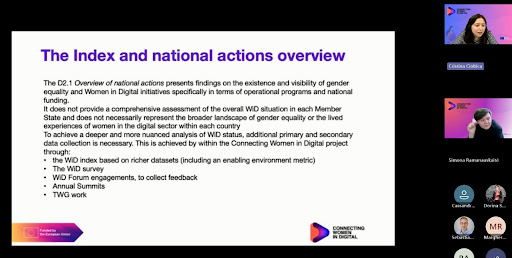
Cristina Ciobica, the second speaker, explained how the findings from Simona’s analysis feed into the wider Connecting Women in Digital project. She clarified that the deliverable (D2.1) is not an evaluation of how each Member State is performing on gender equality or the lived experiences of women, but rather an overview of the visibility of gender-specific initiatives within operational programmes and national funding.
She further explained that the Women in Digital Index combines quantitative indicators with qualitative insights drawn from the Women in Digital Survey, engagement within the Women in Digital Forum, the annual summit, and thematic working groups.
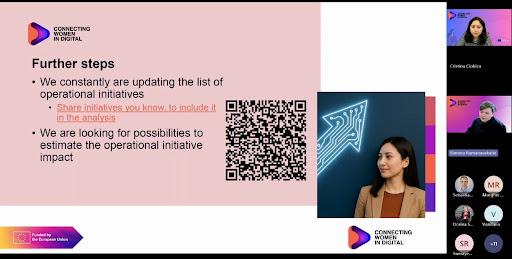
The webinar concluded with a call for continued engagement and contribution through the Connecting Women in Digital Forum and thematic working groups, recognising that mapping and measurement are only first steps. As Simona noted in closing, progress on gender equality in ICT is gradual but visible: “Fifteen years ago, when we were asked when we would have an equal situation in ICT, the answer was ‘never.’ Now, we can at least see that change is happening.”


