
The World Economic Forum has published the Global Gender Gap Report 2026 on 16th of September of this year, covering 145 economies and making the claim that 69.2% of the global gender gap has been closed. At the current collective rate, full parity is about 120 years away, and no economy reached it this year. In the constant sample of 97 economies included in every edition since 2006, the gap closed has grown from 64.2% to 69.4%, the highest level recorded so far.
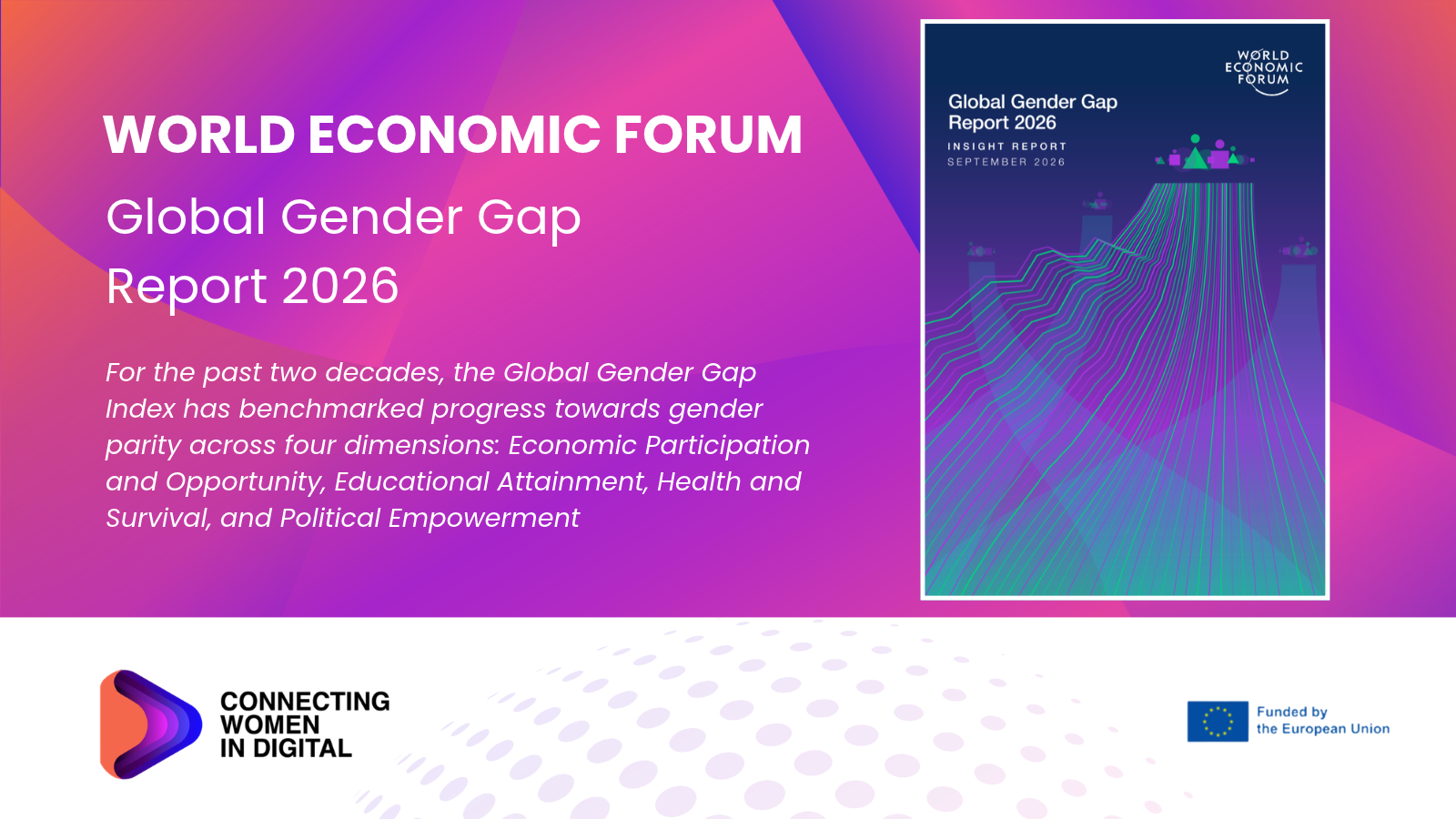
The report measures gender parity with an index that runs on a 0 to 1 scale, and its scores can be read as the percentage of the gender gap that has been closed. As such, a score of 69.2% means that this much of the distance to parity has been covered. The overall results draw on four subindexes. Economic Participation and Opportunity covers labour-force participation and estimated earned income, as well as the presence of women among legislators, senior officials and managers and among professional and technical workers. Educational Attainment controls enrolment and adult literacy, Health and Survival checks the sex ratio at birth and healthy life expectancy and, finally, Political Empowerment covers women’s representation in parliament and in ministerial positions, together with a head of state indicator. The years to parity figures are projections that assume the current rate of progress continues. The global estimate follows the trend of the constant sample between 2006 and 2026, and regional and subindex estimates apply the same logic to their own pace, so every figure changes when the pace changes.
A ranking led by Iceland and Europe
Iceland tops the ranking for the seventeenth consecutive year with 93%, and it is the only economy above 90%. Finland follows with 87.2% and Norway with 85.7%. Namibia ranks fourth with 84.5%, the highest result in Sub-Saharan Africa, and Australia enters the top 10 for the first time at 81.9%. Seven of the ten places belong to European economies, including the United Kingdom, Sweden, Germany and Ireland.
Europe is also the leading region, with 75.7% of its gap closed and about 70 years to parity. Northern America follows at 75.2% and Latin America and the Caribbean at 74.5%, the latter with an estimated 60 years to parity. At the other end, the Middle East and North Africa stands at 62.5% and Central Asia has the longest estimated wait, at 202 years. Since 2006, nine economies have gained more than 12 points, among them Namibia and France.
Economic power and political power remain the widest gaps
The four subindexes show very different situations. Educational Attainment stands at 96.9%, with about eight years to parity, and Health and Survival at 96.2%, a figure that has barely moved since 2006. Economic Participation and Opportunity reaches 61.7%, which corresponds to 129 years. Political Empowerment has the widest gap at 22.1%, with 194 years to parity, although it also recorded the largest long-term gain of the four, at 8 percentage points.
Europe shows what sustained change looks like in these two areas. Since 2006, parity among legislators, senior officials and managers has risen from 36.9% to 52.9%, and parity among professional and technical workers from 83.4% to 96.5%. Parity among heads of state has grown from 5.4% to 16.6%. Progress is not guaranteed, however, as Northern America’s Political Empowerment score fell by 3.3 points between 2025 and 2026.
The report observes that closing the gap “becomes increasingly more demanding”. It indicates that further progress depends more on economic mobility, resource allocation and decision-making power than on access and participation alone. Enforcement of existing reforms is uneven, with paternity leave rated poorly and protections for flexible work and recruitment weaker than the right to work itself.
What the workplace data show
LinkedIn data included in the report describe the labour market in more detail. Women’s share of the workforce rose from 39.9% in 2015 to 41.8% in June 2026, and their share of senior leadership from 26.7% to 29.6%. Hiring of women has stalled since 2022 and shows early signs of decline.
The share of women falls from 46% at entry level to 23% in the C-suite, and women remain underrepresented in stepping-stone roles such as chief financial officer and chief operating officer. Women are almost twice as likely as men to take career breaks, mostly for full-time parenting. Over the past decade, the share of women among Fortune Global 500 CEOs has grown from 2.8% to 6.4%.
Artificial intelligence reproduces existing divides
The report also examines the AI economy, where it finds that the existing segregation by sector and occupation is being reproduced. Women are underrepresented along the AI value chain, from infrastructure to foundation models and applications. They make up nearly half of data annotators but about one fifth of developers and deployment engineers.
Mentions of the founder role on LinkedIn grew by 60% between 2024 and 2025, while women’s share of founders stayed at 28%. In 2026, 8.7% of female founders have AI engineering skills, compared with 14.7% of male founders.
The report’s findings follow the same path that the Women in Digital Index traces through its four pillars. Education is close to parity, so the widest gaps appear after women enter the labour market, in hiring, in career progression and in access to senior roles. This is the territory of the Digital and Leadership pillars, and it is the reason the Index follows women beyond graduation and into leadership positions. The findings on AI add a question for the STEM and ICT pillars, namely whether the skills built in education lead to roles in the technologies that are reshaping the labour market. The difference in AI engineering skills among founders suggests that this transition is still incomplete. The Women in Digital Index is available at index.widigital.eu, and the full Global Gender Gap Report 2026 can be read on the World Economic Forum website.


